 Curvefinance
Curvefinance veCRV turns a CRV lock into time-weighted voting power
Curvefinance veCRV gives an address voting power when it locks CRV for a chosen term. The vote-escrowed CRV balance depends on the locked amount and the time remaining before withdrawal becomes available. It falls linearly as expiry approaches, while the escrowed CRV amount stays unchanged. A direct lock also gives its holder access to protocol revenue sharing and can boost CRV rewards on eligible gauge-staked liquidity. veCRV remains tied to the locking address and cannot be transferred. Locked CRV stays unavailable until expiry. Choosing a term therefore means weighing governance participation and related benefits against access to the underlying CRV.
Updated ·
Extending a CRV lock increases voting power by moving its expiry later, so the same tokens stay unavailable for longer.
CRV approval and the recorded lock
A direct lock on Ethereum starts with spendable CRV and ends with an escrow record showing its amount and expiry. Missing spending allowance prevents the escrow contract from taking the selected tokens.
| Lock creation stage | Required balance or contract state |
|---|---|
| Select the CRV amount and locking address | The intended lock holder controls a sufficient spendable CRV balance. |
| Choose an unlock date | The rounded end time lies in the future and within the contract’s maximum term. |
| Authorize escrow spending if needed | The escrow’s CRV allowance covers the selected amount. If a nonzero allowance is too small, reset it to zero before approving the needed amount. |
| Submit lock creation | No previous locked balance remains uncleared; the amount, allowance and unlock time satisfy the contract. |
| Read the accepted lock | A successful transaction establishes the recorded CRV amount and unlock time. |
Allowance and transaction status
Approval gives the escrow permission to spend CRV, while lock creation establishes the commitment. A wallet signature or pending transaction does not establish a confirmed lock, so check transaction status before another attempt.
A reverted lock leaves its escrow state unchanged. An approval completed in an earlier transaction can remain valid after that reversion.
If balance, allowance or unlock time caused a reversion, correct that condition before trying again. An unexpired position needs an amount increase or extension. Stop before submission if the selected CRV must remain accessible before expiry; direct escrow offers no early withdrawal option.
The accepted escrow record
The recorded amount identifies the committed CRV, and the unlock time defines its withdrawal boundary. Together they determine the address’s veCRV balance. These readings establish that locking succeeded, independently of later fee claims, gauge allocations or liquidity rewards.
How much voting power does a CRV lock create?
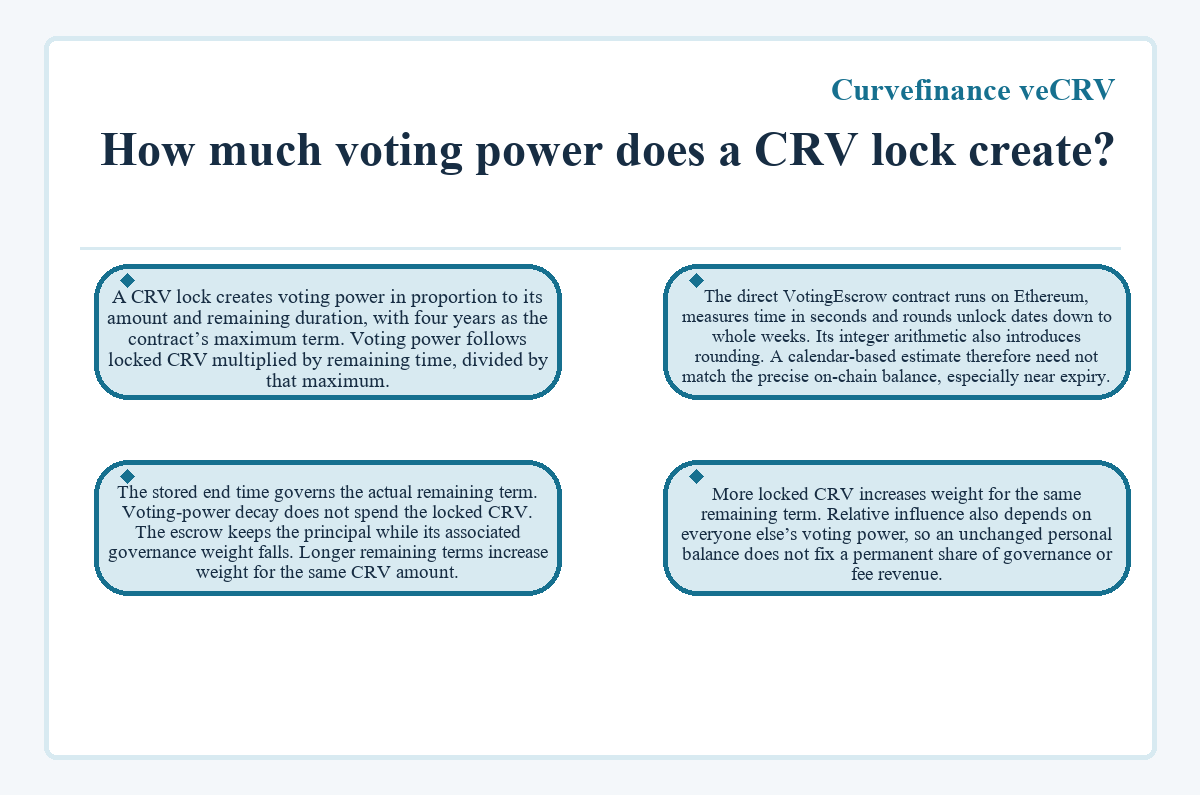
A CRV lock creates voting power in proportion to its amount and remaining duration, with four years as the contract’s maximum term. Voting power follows locked CRV multiplied by remaining time, divided by that maximum. The direct VotingEscrow contract runs on Ethereum, measures time in seconds and rounds unlock dates down to whole weeks. Its integer arithmetic also introduces rounding. A calendar-based estimate therefore need not match the precise on-chain balance, especially near expiry. The stored end time governs the actual remaining term.
Voting-power decay does not spend the locked CRV. The escrow keeps the principal while its associated governance weight falls.
Longer remaining terms increase weight for the same CRV amount. More locked CRV increases weight for the same remaining term. Relative influence also depends on everyone else’s voting power, so an unchanged personal balance does not fix a permanent share of governance or fee revenue.
Governance votes and gauge allocations
Proposal votes use veCRV to influence DAO decisions, while gauge votes allocate CRV emissions among eligible gauges. A gauge tracks staked liquidity for a pool or lending market. Its CRV allocation supports depositor incentives. Voting for a gauge does not itself pay CRV to the voter. Voting takes place on Ethereum, including votes affecting supported deployments elsewhere. Gauge allocations can span multiple gauges, with total assigned voting power capped at 100%. A higher relative gauge weight directs a larger share of the applicable CRV emissions toward that gauge.
Gauge allocation changes take effect at the next weekly boundary, Thursday at 00:00 UTC. A weekly boundary does not erase an existing allocation. The assigned percentage can persist while its underlying voting weight decays.
The GaugeController requires 10 days between an address’s votes on the same gauge. A new gauge vote also requires the lock to extend beyond the next weekly boundary. A positive veCRV balance alone therefore does not establish eligibility for every gauge vote.
Adding CRV or extending a lock raises its voting power without automatically updating existing gauge votes. A fresh vote can reflect that increase, subject to the same delay. Each on-chain vote also incurs Ethereum transaction fees.
Weekly revenue and claim eligibility
Protocol revenue for direct veCRV holders includes distributed trading fees and a portion of crvUSD borrowing interest. Fee distribution pays crvUSD, with legacy 3CRV balances handled separately. This revenue belongs to the fee-sharing mechanism; CRV emissions belong to liquidity gauges.
The fee distributor uses historical veCRV balances and total voting supply at weekly boundaries. A holder’s share therefore reflects the relevant week’s records, not simply the balance displayed when claiming. Eligible revenue also depends on the funds that reach the distributor, so locking establishes participation without fixing a return.
A new lock must span a full revenue week, running from Thursday at 00:00 UTC to the following Thursday. Claimability then depends on the completed week’s fee processing. Locking partway through a week does not create an immediate fee payment.
Fee claims occur on Ethereum and transfer the distributor’s reward token to the lock holder. Claiming these fees does not withdraw or extend the underlying CRV lock.
What does veCRV boost in a liquidity gauge?
veCRV boosts CRV reward accounting for eligible gauge-staked liquidity, with a standard maximum of 2.5x relative to its unboosted working balance. The gauge calculates a working balance for CRV allocation while leaving the actual staked LP token amount unchanged. The boost compares a holder’s share of the gauge’s voting supply with their share of staked liquidity. External incentive tokens receive no veCRV boost. Holding veCRV without a staked position creates no liquidity boost. Where a gauge uses a cross-network voting-power oracle, new lock data can arrive later.
Lock adjustments and access to the underlying CRV
An active lock can accept additional CRV or a later expiry, while its owner remains committed until the recorded unlock time.
Additional CRV under the same expiry
Adding CRV increases the escrowed amount and voting power at the existing expiry. Those additional tokens inherit the current lock’s end date. The contract does not open a separate tranche with its own duration.
One address has one direct lock, so a second deposit changes that shared position. Separate unlock schedules require separate locking addresses.
A later unlock date
An extension keeps principal unchanged and increases the remaining term. A lock extension cannot set the unlock time more than four years after the extension transaction. The new rounded expiry must also exceed the existing end time. Repeated extensions can keep CRV locked beyond four years from the original deposit. Each extension measures its limit from its own execution time.
Both adding CRV and extending time require an unexpired lock. An expired position must have its old CRV withdrawn before that address can create a new lock.
Direct withdrawal and liquid locker tokens
A liquid locker can issue a separate derivative while its contract holds the underlying veCRV. The derivative follows that project’s revenue-claiming and exit arrangements. A transferable derivative can change holders while the underlying CRV stays locked.
For a direct lock, expiry reduces voting power to zero and permits withdrawal without automatically returning the tokens. Withdrawal clears the recorded lock and transfers the full recorded principal to the locking address in CRV.
Curvefinance veCRV: reader questions
-
Can a multisig create a direct veCRV lock?
- A multisig or smart contract can create a direct veCRV lock under the current smart-wallet checker. The checker accepts contract wallets without the former whitelist requirement. Wallet compatibility with a particular interface remains separate from this contract-level permission. The lock belongs to the address that creates it, so its signing controls also govern lock extensions and withdrawal.
-
Why can adding CRV leave my liquidity boost unchanged?
- A larger CRV lock does not automatically refresh the working balance that a liquidity gauge uses for your boost. Gauge interactions, such as a deposit, withdrawal or CRV claim, update that accounting. A gauge using a voting-power oracle also needs the relevant lock data to reach that oracle. The fee-sharing balance and the gauge’s stored boost can therefore update at different times.
-
Must I claim veCRV fee revenue every week?
- Unclaimed fee revenue accumulates, so skipping a weekly claim does not forfeit the balance. Claiming later still requires an eligible recorded entitlement and a transaction on Ethereum. Current crvUSD rewards and legacy 3CRV rewards have separate claims. This accumulated revenue is distinct from the CRV principal that remains inside the lock until expiry.
-
Is my locked CRV amount visible to other people?
- Anyone can read an address’s locked CRV amount, unlock time and veCRV voting power from the public contract. The address does not need to sign a transaction to expose those readings. A multisig or smart-contract wallet follows the same public accounting model, so its permission rules do not make the escrow record private.
-
Does voting on one DAO proposal prevent votes on other proposals?
- Voting on one DAO proposal does not consume your veCRV or block votes on other proposals for which you are eligible. Each proposal has its own starting snapshot, so the locking address must already hold veCRV when that vote begins. Gauge allocations instead share a percentage limit across the selected gauges.